Migraine is more than an occasional headache. Recurrent attacks can affect work, sleep, family life, travel and the ability to follow a normal daily routine.
This often leads people to explore different approaches to long-term migraine management, including Ayurveda.
Ayurvedic treatment for migraine generally involves more than giving the same medicine to every patient. Ayurvedic assessment considers the characteristics of the headache together with digestion, sleep, diet, stress, bowel habits, daily routine and the individual's constitution before treatment is planned.
Depending on the assessment, management may include dietary changes, lifestyle measures, Ayurvedic medicines and selected therapies such as Nasya or other Panchakarma procedures.
First, What Is Migraine?
Migraine is a neurological disorder characterised by recurrent attacks.
A migraine attack can involve:
- throbbing or pulsating head pain
- pain on one or both sides
- nausea
- vomiting
- sensitivity to light
- sensitivity to sound
- sensitivity to smells
- worsening of pain with normal physical activity
Some patients experience aura, while many do not.
Because headaches can also occur for other reasons, diagnosis matters. A new, severe or unusual headache should not automatically be assumed to be migraine.
How Is Migraine Understood in Ayurveda?
Ayurvedic texts describe different types of Shirashoola, or disorders involving head pain. A condition called Ardhavabhedaka is commonly discussed in modern Ayurvedic practice when evaluating clinical patterns resembling migraine.
Ayurvedic interpretation may consider the involvement of Vata, Pitta and, in some presentations, Kapha.
However, Ayurvedic assessment should not be reduced to statements such as "all migraines are caused by Pitta".
Two people with a medical diagnosis of migraine may have very different:
- digestive patterns
- sleep quality
- headache characteristics
- triggers
- stress levels
- associated symptoms
- constitutions
- medical histories
This is why personalised assessment is central to classical Ayurvedic care.
What Happens During an Ayurvedic Migraine Consultation?
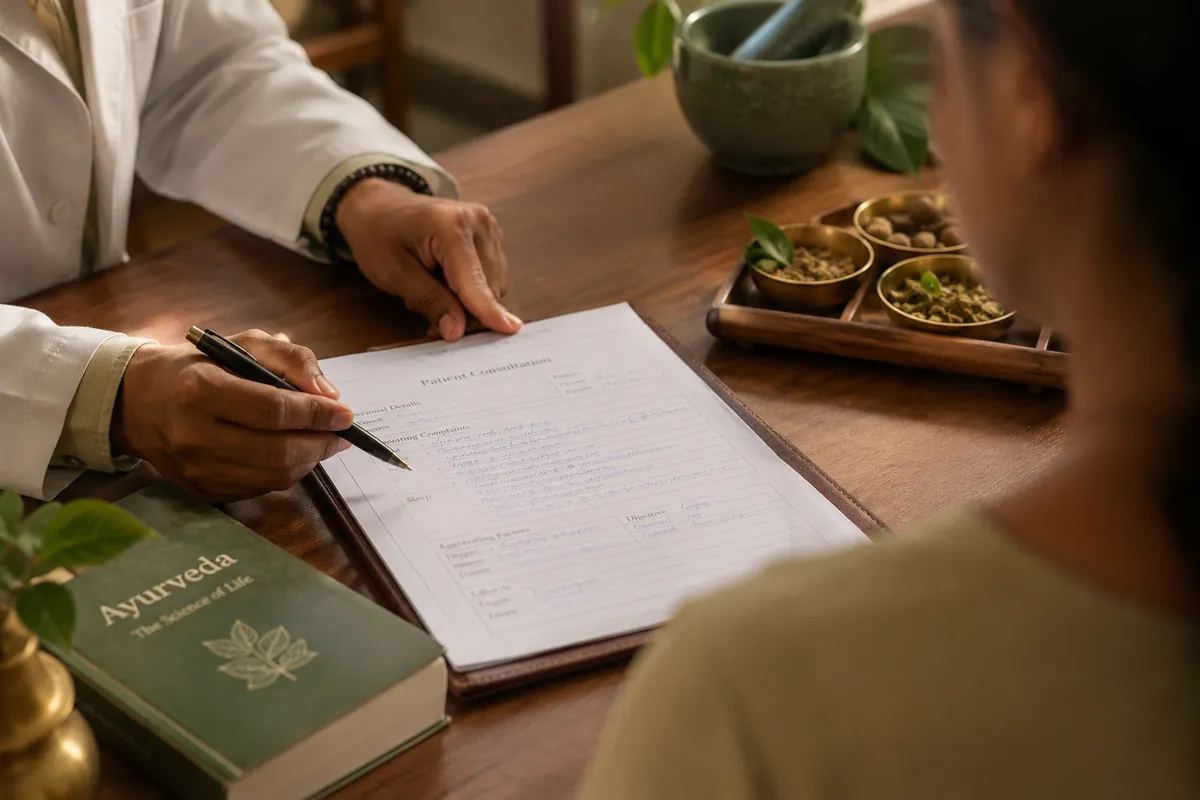
If you are considering migraine treatment in Ayurveda, a proper consultation should begin before medicines or therapies are prescribed.
The physician may ask about:
Headache history
This includes:
- when migraines started
- number of attacks
- frequency each month
- duration
- severity
- location
- type of pain
- aura
- nausea
- vomiting
- sensitivity to light or sound
Known triggers
Possible triggers may include:
- stress
- irregular meals
- disturbed sleep
- menstruation
- alcohol
- sensory exposure
- travel
- dehydration
- particular foods
Digestive health
Ayurveda gives considerable attention to appetite, digestion, bowel habits and the relationship between symptoms and food.
Daily routine
Work timings, screen exposure, sleep, exercise, meals and stress may all be discussed.
Existing medicines
Patients should tell their Ayurvedic doctor about all prescription medicines, over-the-counter medicines and supplements they currently use.
Do not discontinue prescribed migraine medicine simply because you have started Ayurvedic care.
What Can Ayurvedic Treatment for Migraine Include?
No single treatment combination is appropriate for every person.
A plan may involve some of the following.
1. Diet and Meal Regularity
Irregular meals and fasting can trigger migraine in some people.
Dietary recommendations may therefore focus on regular meal timing and foods appropriate for the individual's digestive pattern and Ayurvedic assessment.
The objective should not be to impose a long list of unnecessary restrictions.
A practical plan that a patient can maintain is usually more useful than an extreme short-term diet.
2. Sleep and Daily Routine
Sleep disruption is a recognised migraine trigger.
Ayurvedic lifestyle advice may therefore include maintaining:
- consistent sleep timing
- consistent meal timing
- adequate rest
- appropriate physical activity
- a daily routine suited to the person's circumstances
This overlaps with modern migraine management, where stable routines are often helpful.
3. Stress Management
Stress is a common migraine trigger.
Depending on the patient, recommendations may include relaxation practices, suitable yoga, breathing exercises or other changes intended to reduce repeated stress exposure.
These measures should complement rather than replace appropriate medical treatment.
4. Ayurvedic Medicines
An Ayurvedic medicine for migraine should ideally be prescribed after individual assessment rather than purchased solely because it is advertised for headaches.
Formulation selection can depend on the person's symptoms, constitution, digestive health and other medicines.
Ayurvedic products can also cause adverse effects or interact with medicines.
Patients should therefore tell both their Ayurvedic and conventional healthcare professionals what they are taking.
5. Nasya
Nasya involves the administration of specifically selected substances through the nasal route according to Ayurvedic practice.
It is frequently discussed in classical and clinical Ayurvedic approaches to disorders affecting the head and has also appeared in research involving Ayurvedic management of migraine.
However, Nasya should not be treated as a universal home remedy.
The substance, timing, dose and suitability should be determined by a qualified Ayurvedic physician.
6. Panchakarma
Selected Panchakarma procedures may be considered for some patients after assessment.
Protocols described in Ayurvedic migraine research have included procedures such as Nasya and Virechana.
Panchakarma is not one fixed "migraine detox".
The appropriate procedure, if any, depends on the individual.
7. Shirodhara and Other Supportive Therapies
Shirodhara involves the controlled flow of a suitable liquid, commonly medicated oil, over the forehead.
In Ayurvedic practice it may be incorporated into a broader management programme, particularly where relaxation and sleep are being addressed.
Shirodhara should not be presented as a proven standalone cure for migraine.
It is better understood as one possible component of an individualised Ayurvedic plan.
What Does Research Say About Ayurveda for Migraine?
Research into Ayurveda for migraine exists, but the evidence needs to be interpreted carefully.
A published review of clinical research identified multiple studies evaluating Ayurvedic interventions for migraine. Some reported improvement with approaches involving Ayurvedic formulations, Panchakarma procedures or integrated Ayurveda and yoga programmes.
However, the review also identified important limitations, including small study sizes, short follow-up periods and methodological issues.
The evidence therefore supports continued research, but it is not appropriate to promise that Ayurvedic treatment will permanently cure migraine in every patient.
A responsible clinic should explain both the potential role and the limitations of treatment.
How Long Does Ayurvedic Migraine Treatment Take?
There is no evidence-based universal duration that applies to every migraine patient.
Treatment duration can depend on:
- how long migraine has been present
- attack frequency
- attack severity
- associated symptoms
- other health conditions
- treatments selected
- response over time
Be cautious of any claim that every person with migraine can be cured within an identical number of days or months.
Can Ayurveda Be Used Alongside Conventional Migraine Care?
In some cases, Ayurveda may be used as part of an integrative approach.
If you already take preventive or acute migraine medicines, inform your Ayurvedic physician.
Likewise, tell your neurologist or other treating doctor about Ayurvedic medicines and supplements you use.
Coordinated care becomes especially important where a patient has chronic migraine, other medical conditions or takes multiple medicines.
When Is Migraine Not Something to Treat at Home?
Urgent medical assessment is required for symptoms such as:
- a sudden, extremely severe headache
- new weakness or numbness
- difficulty speaking
- confusion
- seizures
- significant head injury
- fever with marked neck stiffness
- a major unexplained change in the usual headache pattern
Ayurvedic treatment should never be used to delay emergency evaluation in these situations.
Choosing Ayurvedic Treatment for Migraine in Bengaluru
If you are searching for Ayurvedic treatment for migraine in Bengaluru, look beyond claims such as "permanent cure" or "instant relief".
A useful consultation should involve:
- detailed headache assessment
- review of previous diagnosis and reports where relevant
- assessment of current medicines
- individualised Ayurvedic evaluation
- clear explanation of recommended therapies
- realistic treatment goals
- follow-up and progress monitoring
Treatment should be adapted according to response rather than provided as the same package to every patient.
What to Expect at SriPAA Migraine & Headache Centre
At SriPAA Ayurveda, migraine and headache care is positioned as a focused clinical service within the wider SriPAA Ayurveda system.
At the SriPAA Migraine & Headache Centre in Bengaluru, the assessment can consider the patient's migraine history together with Ayurvedic clinical evaluation, diet, digestion, sleep, lifestyle and triggers before an individual care plan is developed.
The objective of migraine management should be realistic: reducing the burden of attacks, supporting better day-to-day functioning and addressing modifiable factors relevant to the individual patient.
Frequently Asked Questions
Is Ayurvedic treatment effective for migraine?
Some clinical studies have reported benefit from Ayurvedic approaches, but the overall evidence base remains limited and more high-quality research is needed. Outcomes can vary considerably between individuals.
What is the Ayurvedic name for migraine?
Ardhavabhedaka is an Ayurvedic condition frequently discussed in relation to migraine-like clinical presentations. A direct one-to-one equivalence should not replace proper diagnosis.
Which Ayurvedic therapy is used for migraine?
Depending on individual assessment, Ayurvedic management may include diet and lifestyle measures, medicines, Nasya and selected Panchakarma or supportive procedures. There is no single therapy suitable for every migraine patient.
Can Ayurveda permanently cure migraine?
Migraine is a recurrent neurological disorder, and no responsible treatment should guarantee a permanent cure for every patient. Management aims can include reducing frequency, severity and the overall impact of attacks.
Where can I consult an Ayurvedic doctor for migraine in Bengaluru?
Patients seeking Ayurvedic migraine care in Bengaluru can consult the SriPAA Migraine & Headache Centre for individual evaluation before a treatment plan is recommended.
This article is for general information only and is not a substitute for medical advice. Please consult a qualified doctor about your symptoms.